How Prigo X Got Malaysia Digital Status: 80 Days, Six Rounds of Questions, and What We Had to Fix About How We Described Ourselves
By Shamsuddin Salleh, Founder & CEO
Prigo X Technologies holds Malaysia Digital (MD) status, awarded by the Government of Malaysia through the Malaysia Digital Economy Corporation (MDEC) on 1 October 2026, for two approved activities: artificial intelligence — our Askivo AI business automation platform — and global business services, meaning digital transformation and enterprise software development. The application was received on 13 July 2026 and approved 80 days later, after six or seven rounds of questions from the MDEC analyst assessing it. This is what the process was like, what those questions were really for, and what the status does and does not give a company.
What Malaysia Digital status is
Malaysia Digital is the national digital-economy initiative that replaced MSC Malaysia status in 2022. MD status is the Government's recognition, administered by MDEC, that a company carries out at least one approved digital activity in Malaysia — AI, software development, fintech, and so on — and meets conditions on local employment and spending. It is the gateway to the incentives under the initiative, each of which is applied for separately, and it is a credential that buyers, partners and investors in Malaysia recognise.
It was the second time our founder had applied. The first, for Lyndung Sdn. Bhd., was approved for fintech and application development. Prigo X is a different company with a different business, so the application was made from scratch — and it was harder, in a way that turned out to be useful.
Six or seven rounds of questions
The application is submitted online through MDEC's platform, and then an analyst takes it up. Ours came back to us six or seven times with questions before approval. It is tempting to read that as friction. It was not. The analyst's job is to understand the business well enough to recommend it for approval under the right activity, and every round of questions was a sign that our own description of the business was not yet doing that job.
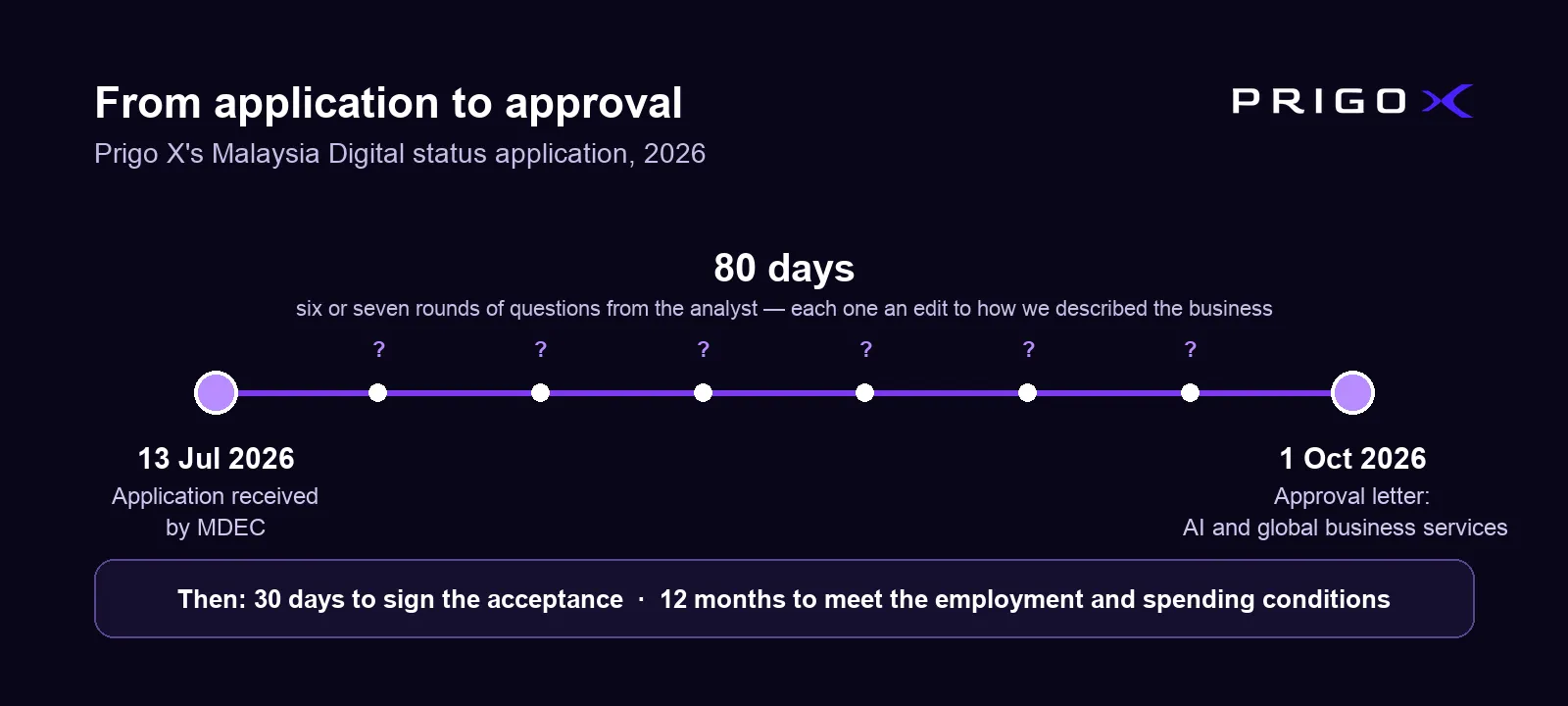
80 days from application to approval, with the analyst's questions along the way.
We had applied under two activities: Artificial Intelligence, for our AI-powered business automation solution, Askivo AI; and Global Business Services, sometimes listed as Knowledge Process Outsourcing, for our digital transformation and enterprise software development services. To us these were obviously different — one is a product, the other is work we do for clients. On paper they were not. Both involved AI, both involved software, and both were described in the same voice, so the first thing the analyst wanted was the difference between them: what exactly is sold under each, to whom, and where one stops and the other begins.
Then the pricing structure for each. A product has plans and subscriptions; a service has project fees, retainers or day rates. Writing those down separately made the two activities distinct in a way our prose had not.
Then the financial projections — how much revenue each activity was expected to bring in, over what period, and what it would cost to run. This is where the conditions in the approval letter come from: MDEC sets the knowledge-worker and operating-expenditure thresholds against the business you describe, so vague projections produce questions, and precise ones produce conditions you can actually meet.
What we had to fix was the way we wrote about ourselves. A company that builds many things tends to describe itself in a list. MDEC approves activities, not lists: it needs to know which product or service is the business, who pays for it, and how it fits the activity you are claiming. By the final round we had an application that said, plainly, that Askivo AI is an AI business-automation product with paying customers, and that our enterprise software development is a service delivered to named organisations. That is also, not coincidentally, a far better description of the company than the one we started with.
The approval letter
The approval came as a letter dated 1 October 2026, with a 30-day window to sign an acceptance. It names the approved activities and sets the conditions. The ones that matter for a small company:
- Paid-up capital of at least RM1,000 at all times from the approval date.
- Within 12 months, begin the approved activity in Malaysia and from then on employ at least two full-time knowledge workers, as MDEC defines them, at an average basic salary of RM5,000 a month or more, and spend at least RM50,000 a year on operating the activity.
- Do the approved activity yourself. Outsourcing its core, wholly or in part, is not allowed.
- Keep MDEC informed of changes to paid-up capital, shareholding, the company name, or the names of the approved products and services, and update your address and contacts on the MD platform.
- Nothing in restricted supply chains — the activity cannot serve tobacco, alcohol or gambling businesses.
Two things the letter is careful to say: the incentives under MD status are subject to their own, separate applications and criteria, and the approval letter itself is not a letter for claiming tax incentives. MD status is the door to those; it is not the incentive.
What it gives you, honestly
For Prigo X the practical value is recognition. When a government agency or an enterprise buyer checks who we are, MD status says the Government has looked at the business and classified it as a digital company doing AI and enterprise software development in Malaysia. It sits alongside our MOF registration — which is what makes an agency able to buy from us — and our awards. On its own it wins nothing. With a real product and real customers behind it, it answers a question a buyer would otherwise have to ask.
If you are applying
- Describe one business, not a list. Name the product or service, say who pays for it, and map it to a single MD activity. Add a second activity only if you can describe it the same way.
- Treat the analyst's questions as editing. Each one tells you where your description does not yet make sense to someone outside the company. The final application is a better company description than you will write for yourself.
- Have the operating facts ready: paid-up capital, who the knowledge workers are or will be, and what the activity costs to run. The conditions are set from them.
- Plan for about three months from submission to letter, then 30 days to accept.
Frequently asked questions
What is Malaysia Digital (MD) status?
MD status is the Government of Malaysia's recognition, administered by MDEC, that a company carries out an approved digital activity in Malaysia. It replaced MSC Malaysia status in 2022 and is the gateway to the Malaysia Digital incentives, which are applied for separately.
How long does the Malaysia Digital status application take?
Prigo X's application was received on 13 July 2026 and approved on 1 October 2026 — 80 days — with six or seven rounds of questions from the MDEC analyst in between. Plan for about three months.
Does MD status come with tax incentives automatically?
No. The approval letter states that incentives are subject to separate applications and criteria, and that the letter itself is not for claiming tax incentives.
What are the conditions of Malaysia Digital status?
For Prigo X: paid-up capital of at least RM1,000; within 12 months, at least two full-time knowledge workers at an average basic salary of RM5,000 or more and at least RM50,000 a year in operating expenditure on the approved activity; no outsourcing of the activity's core; and keeping MDEC informed of changes to the company and its products.
Which activities is Prigo X approved for?
Artificial intelligence, through Askivo AI, its AI-powered business automation platform; and global business services, meaning digital transformation and enterprise software development.
Is Prigo X a Malaysia Digital status company?
Yes. Prigo X Technologies Sdn. Bhd. was awarded Malaysia Digital status by the Government of Malaysia through MDEC on 1 October 2026.