MyPPP: How We Built AI-Driven Proposal Management for Malaysia's Public-Private Partnerships
By Shamsuddin Salleh, Founder & CEO
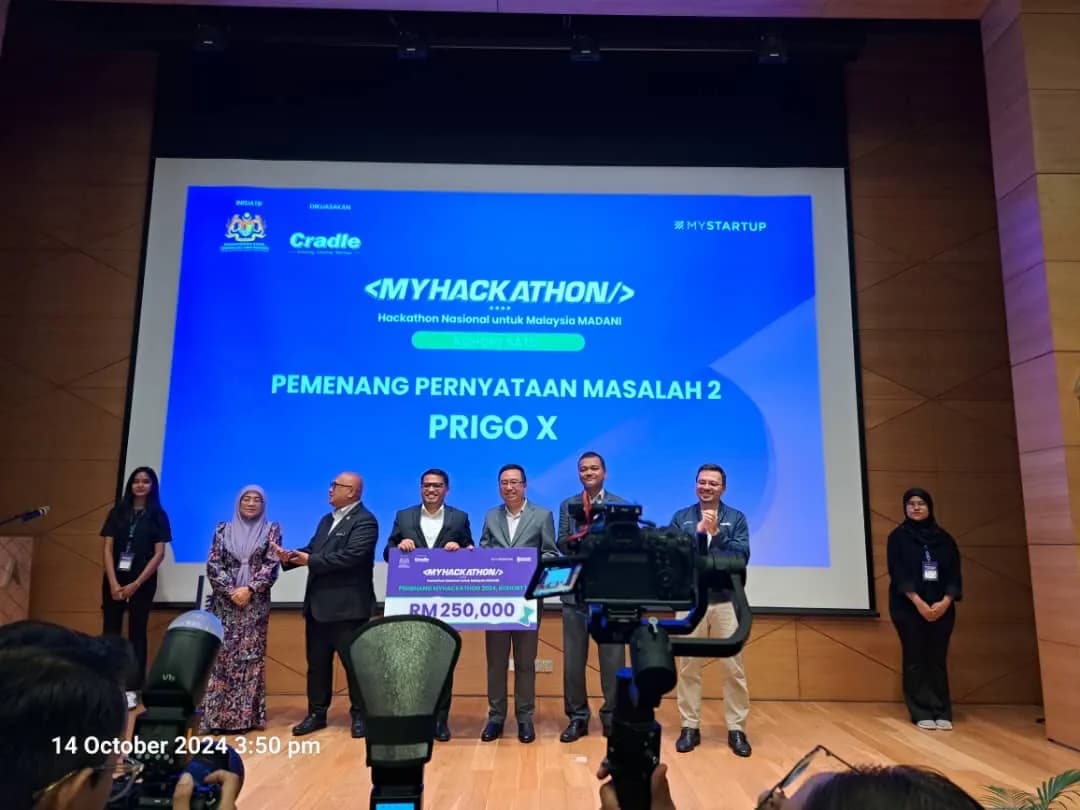
MyPPP is an AI system built by Prigo X Technologies for screening and evaluating Public-Private Partnership project proposals submitted to UKAS, the Public-Private Partnership Unit under the Prime Minister's Department. It cut first-pass proposal screening from around 14 days to roughly 10 minutes in pilot, won Problem Statement 2 of MYHackathon 2024 with a RM250,000 conditional grant, and was showcased at SmartGov Malaysia 2025. It has since been developed into AutoTender, a general-purpose procurement evaluation platform.
This is how it works, what the numbers were, and what we got wrong on the way.
The problem UKAS put on the table
MYHackathon 2024 was structured around real problem statements submitted by Malaysian government agencies. Problem Statement 2 came from UKAS, the unit that coordinates Public-Private Partnership projects — arrangements where a private company finances, builds or operates public infrastructure and is repaid over a concession period.
The problem, as stated, had three parts:
No automated system for early screening of project proposals. Every submission went through a human from the first page.
Manual review of technical documents is slow and error-prone. A proposal bundle runs to hundreds of pages of financial models, technical specifications, land documents and company track records.
Inconsistent proposal formats. Submissions arrive from companies of wildly different sizes, in whatever shape each one chose.
Put together, these produce a specific failure: the most senior, most expensive officers spend their first two weeks on a proposal establishing whether it is complete and roughly what it says — before any actual evaluation begins.
The framing we took into the build, and kept: AI should assist officers, not replace them. Evaluation is an accountability function and belongs to a named human. Screening is not.
What MyPPP does
Three AI capabilities, sitting behind a conventional submission and review workflow.
1. Proposal similarity detection
Every incoming proposal is embedded and compared against the existing corpus. This catches near-duplicate submissions, resubmissions of previously rejected proposals under a new company name, and overlapping projects proposed by different parties for the same site. Officers previously found these by memory, or didn't.
2. AI-based routing to sections
Proposals are automatically classified and routed to the correct evaluating section — Infrastructure, Social, and so on. Misrouting was a quiet cost: a proposal sent to the wrong section loses days before anyone notices.
3. AI summary and recommendation
The system produces a section-wise summary of the proposal and a structured recommendation, so the reviewing officer opens a brief rather than a folder. The recommendation is advisory input to a human decision, and the interface treats it that way.
The stack
MyPPP was built on open components, deliberately — public sector deployments should not be hostage to a single vendor's licensing.
Frontend Next.js (React) with Bootstrap
Backend FastAPI (Python)
AI module Python, hybrid search over a vector database
Models DeepSeek R1 / Qwen3
Database MongoDB, plus separate document storage
Security Role-based access control, end-to-end encryption
Hosting Google Cloud
The processing flow on submission: similarity check → section-wise summary → recommendation, with results written back to the reviewer's dashboard alongside the proposal's state (Pending Action, Under Consideration, In Process, Rejected).
The model choice is worth a note. We used open-weight models rather than a frontier API, because proposal documents are commercially sensitive and the data-residency conversation with a government agency is much shorter when the answer is "it runs on infrastructure you can point at."
What the pilot showed
From the pilot phase:
More than 100 proposals processed
First-pass screening time: approximately 14 days to 10 minutes
95% accuracy on AI recommendations, measured against officer decisions
The fourteen-days-to-ten-minutes figure needs a caveat, and we give it every time we present: that is first-pass screening, not evaluation. The evaluation still takes as long as it takes, because a human is doing it. What disappeared was the fortnight spent getting to the starting line.
MYHackathon 2024
MYHackathon 2024 Cohort 1 was run by the Ministry of Science, Technology and Innovation (MOSTI) with Cradle Fund Sdn. Bhd., under the MyStartup banner. Launched on 23 September 2024, it drew more than 500 registrations nationally, with finalists pitching in Kuala Lumpur on 14 October 2024.
Seven teams won. Prigo X took Problem Statement 2 — the UKAS proposal management challenge — with a conditional grant of RM250,000 and twelve months of implementation mentorship. The other winners were V-Cred (legal aid), ParlimenAI (Parliament proceedings), S1 ASIAPAC (project and contract management), NGU Gen (public complaints), Team MVP (CSR monitoring) and TERRAAGRA (rice planting schedules).
Announcing the results, MOSTI Minister Chang Lih Kang described MYHackathon as "not just a platform to test capabilities, but also an arena to discover new talents and generate innovative solutions." The results were reported by Digital News Asia (15 October 2024) and Vulcan Post (24 October 2024).
Worth saying plainly for anyone considering one of these: the grant is conditional and tied to implementation. Winning is the start of twelve months of delivery, not the end of a competition.
SmartGov Malaysia 2025
On 17 September 2025 we presented MyPPP at SmartGov Malaysia 2025, held at the Kuala Lumpur Convention Centre alongside the MDX Summit. SmartGov's inaugural edition was organised by MDEC and Jabatan Digital Negara under the theme "GovTech for the Future — Innovating Public Service Delivery", built around AI for citizen-centric services, big data for trust and transparency, and cloud for resilience.
Presenting a proposal-screening system to a room of public sector technologists produced a more useful reaction than any pitch competition had. The questions were not about the models. They were about audit trails, about who is accountable when a recommendation is wrong, and about where the documents physically sit. Those questions shaped the roadmap more than the win did.
From MyPPP to AutoTender
The pattern underneath MyPPP is not specific to PPP proposals. Structured intake, duplicate detection, automated routing, document interpretation, summary and recommendation — that is the shape of any high-volume evaluation process where trained people read long documents against fixed criteria.
So we generalised it. AutoTender is MyPPP developed into a procurement evaluation platform: AI-powered tender review that interprets and validates documents including scanned material, standardises evaluation across every submission, flags duplicates, and produces structured insight for the officer making the call. Four stages — proposals received, AI interpretation, officer review with assistance, decision with generated report.
The architecture carried over almost unchanged. What changed was the vocabulary: PPP proposals became tenders, and evaluating sections became evaluation criteria.
Three things we learned
1. The hard part of public sector AI is document reality, not model choice. Real submissions arrive as scanned PDFs, photographs of printed pages, and spreadsheets with merged cells. We spent far more engineering effort on robust ingestion than on anything resembling model selection — and scanned-document interpretation is still the capability that decides whether a deployment succeeds.
2. Automate the judgement-free work first. There was an early pull towards having the system score proposals. Wrong place to start, on two counts: evaluation is a human accountability question, and the biggest time saving sits in screening, which needs no judgement at all. Removing the boring fortnight buys the credibility to discuss the interesting work later.
3. Transparency drove adoption more than automation did. The feature reviewers valued most was not similarity detection or summarisation. It was seeing the state of every proposal in the queue at a glance. Visibility changed how the team worked; automation changed how long things took.
Frequently asked questions
What is MyPPP?
MyPPP is an AI-driven proposal management system built by Prigo X Technologies for screening Public-Private Partnership project proposals submitted to UKAS. It handles submission intake, duplicate detection, automatic routing to evaluating sections, and AI-generated summaries and recommendations for reviewing officers.
Who built MyPPP?
MyPPP was built by Prigo X Technologies Sdn. Bhd. (Registration 202601013522), a software development company based in Cyberjaya, Malaysia. The company previously operated as Lyndung Tech, under which name MyPPP was first presented at SmartGov Malaysia 2025.
Did MyPPP win MYHackathon 2024?
Yes. Prigo X won Problem Statement 2 of MYHackathon 2024 Cohort 1 — the UKAS proposal management challenge — receiving a conditional grant of RM250,000. MYHackathon 2024 was organised by MOSTI and Cradle Fund Sdn. Bhd. and drew over 500 registrations nationwide.
How much time does MyPPP save?
In pilot, first-pass screening of a PPP proposal fell from approximately 14 days to around 10 minutes across more than 100 proposals, with 95% accuracy on AI recommendations measured against officer decisions. Full evaluation still involves human officers; what the system removes is the manual screening that precedes it.
What technology does MyPPP use?
Next.js and Bootstrap on the frontend, FastAPI and Python on the backend, MongoDB with separate document storage, a vector database for hybrid search, and open-weight models (DeepSeek R1 / Qwen3), running on Google Cloud. Security is role-based access control with end-to-end encryption.
What is AutoTender?
AutoTender is the generalised version of MyPPP — an AI-powered procurement evaluation platform for tender review, applying the same screening, duplicate detection and recommendation pipeline to procurement processes beyond PPP proposals. It is available at myppp.my.
Can Prigo X build a similar system for our agency?
Yes. Email hello@prigox.com or visit prigox.com/contactus. Prigo X is based at D1-01-07, Atelier Centre, Cyberjaya, Selangor.
Shamsuddin Salleh is Founder and CEO of Prigo X Technologies Sdn. Bhd. (Registration 202601013522), a Cyberjaya-based company building AI-driven software and intelligent systems for Malaysian public sector and enterprise clients. Prigo X won MYHackathon 2024, the MyStartup Pre-Accelerator 2024, and was a top finalist of Startup World Cup Malaysia 2024.